
The Cloud AI Trap: Your Supply Chain is Your Vulnerability
The cloud exposes your data to Shadow AI and third-party failures. Protect your IP with sovereign on-premise AI and comply with the NIS2 directive.
The elephant in the room
In 2025, 53% of security teams reported being underfunded and 55% understaffed. While human teams suffocate trying to scale their operations, Shadow AI has created new pathways for intellectual property theft. Let's be clear: outsourcing your defensive "brain" to commercial cloud platforms is tactical suicide.
The World Economic Forum (WEF), in its landmark 2026 white paper "Empowering Defenders: AI for Cybersecurity," highlights a critical "defensive asymmetry": attackers only need one entry point, while defenders must protect everything. To regain the advantage, the WEF argues that defenders must use AI to analyze and prioritize risks using internal proprietary data for "contextual precision that attackers lack". Your defense line cannot depend on latent calls to an external API that extracts your corporate telemetry. This operational friction contradicts the principles of active defense established by the NATO Cooperative Cyber Defence Centre of Excellence (CCDCOE). Today, the most devastating failure in organizations is not malware, it is their blind dependence on the commercial supply chain.
For AI to actually strengthen cybersecurity, it needs deep context. We are talking about system logs, vulnerability reports, incident timelines, source code and cloud assets. These systems process the absolute most sensitive information an organization owns. This creates a very uncomfortable question for CISOs:
What happens when that defensive intelligence is sent to a third-party cloud AI provider?
Many companies are currently experimenting with public cloud AI tools and commercial LLM platforms. In cybersecurity, convenience has a cost. When internal telemetry is processed through external services, the organization is no longer operating safely inside its own security perimeter. That data moves into a third-party environment governed by external infrastructure, availability and retention rules. Take OpenAI’s privacy policies or Anthropic's Claude for Work.
Even with enterprise privacy commitments, abuse monitoring logs may retain customer content and feedback data might be stored for years unless specific manual controls are approved.
You have just introduced a massive dependency into the core of your security operations.
Shadow AI is a cybersecurity supply chain risk
For many companies, the biggest exposure doesn’t come from a formal enterprise deployment but from ungoverned usage:
- An analyst pasting logs into a consumer AI account.
- A developer asking a public chatbot to review source code.
- A SOC team summarizing an incident with a generic cloud model.
Together, these actions create a new form of cybersecurity supply chain risk: Shadow AI.
This is a fundamental data sovereignty problem.
If sensitive cyber data is processed by external AI systems without strict rules, companies lose visibility over their security posture. They no longer know exactly what data was shared, who processed it, where it resides geographically or whether it's feeding back into a monitoring loop.
Under the European NIS2 Directive, this lack of visibility is a severe liability. The Directive mandates robust cybersecurity risk management and holds top management accountable. Once external AI providers process your cybersecurity data, they officially become part of your security supply chain.
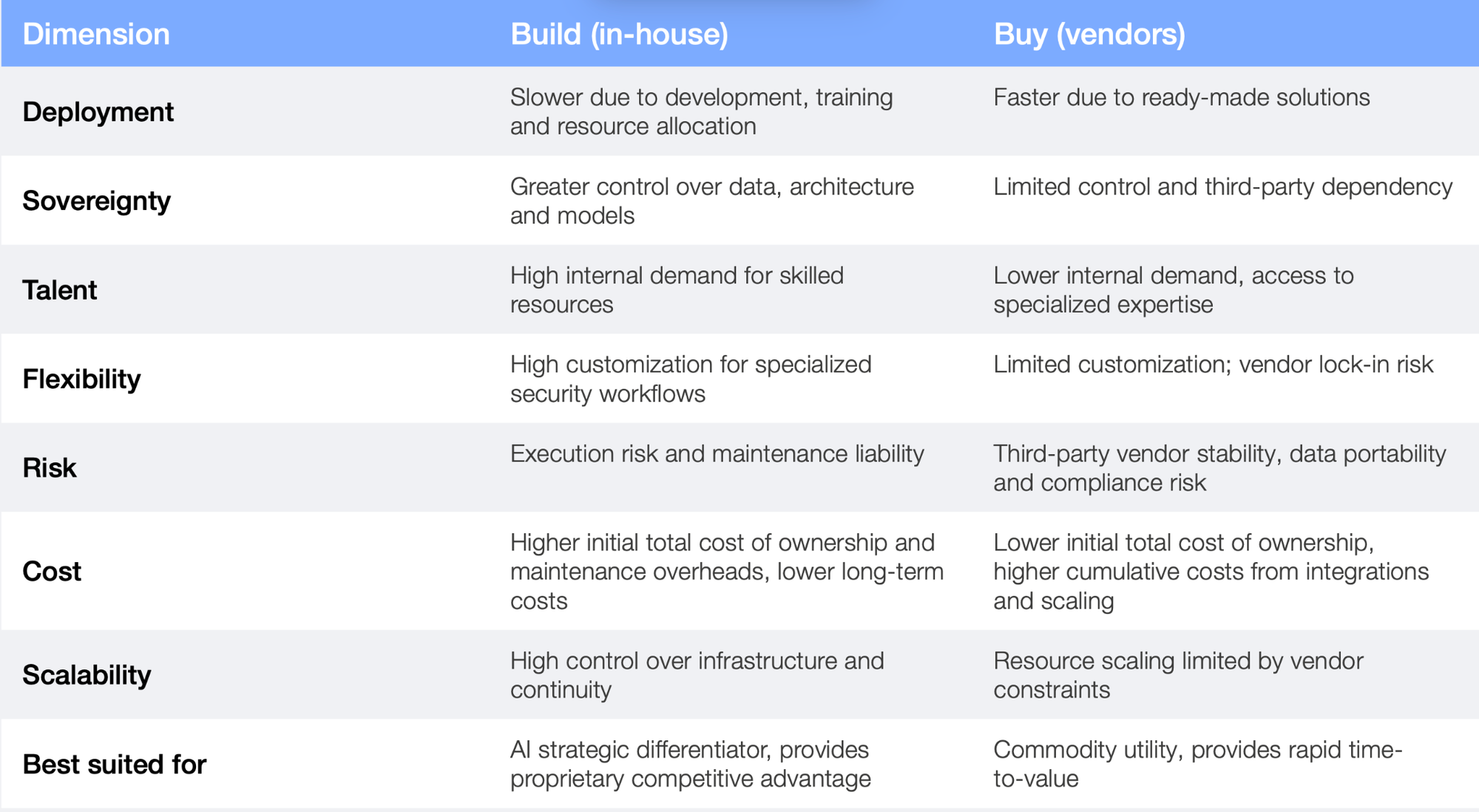
Cloud AI creates operational dependency
A security team relying on external cloud AI for threat detection is entirely at the mercy of the provider’s API availability, rate limits and commercial roadmap.
That might be acceptable for writing marketing emails. It is completely unacceptable when analyzing critical incidents in industrial environments.
The World Economic Forum notes that relying heavily on automated decisions without internal expertise can undermine cyber resilience.
The EU Artificial Intelligence Act (AI Act) reinforces this direction: AI must be transparent and subject to strict governance. AI hosting is a risk decision. AI data flow is a board-level decision.
If an organization cannot confidently explain where its security data goes, it doesn't have an AI strategy but an uncontrolled dependency.
Data sovereignty designed into cybersecurity AI
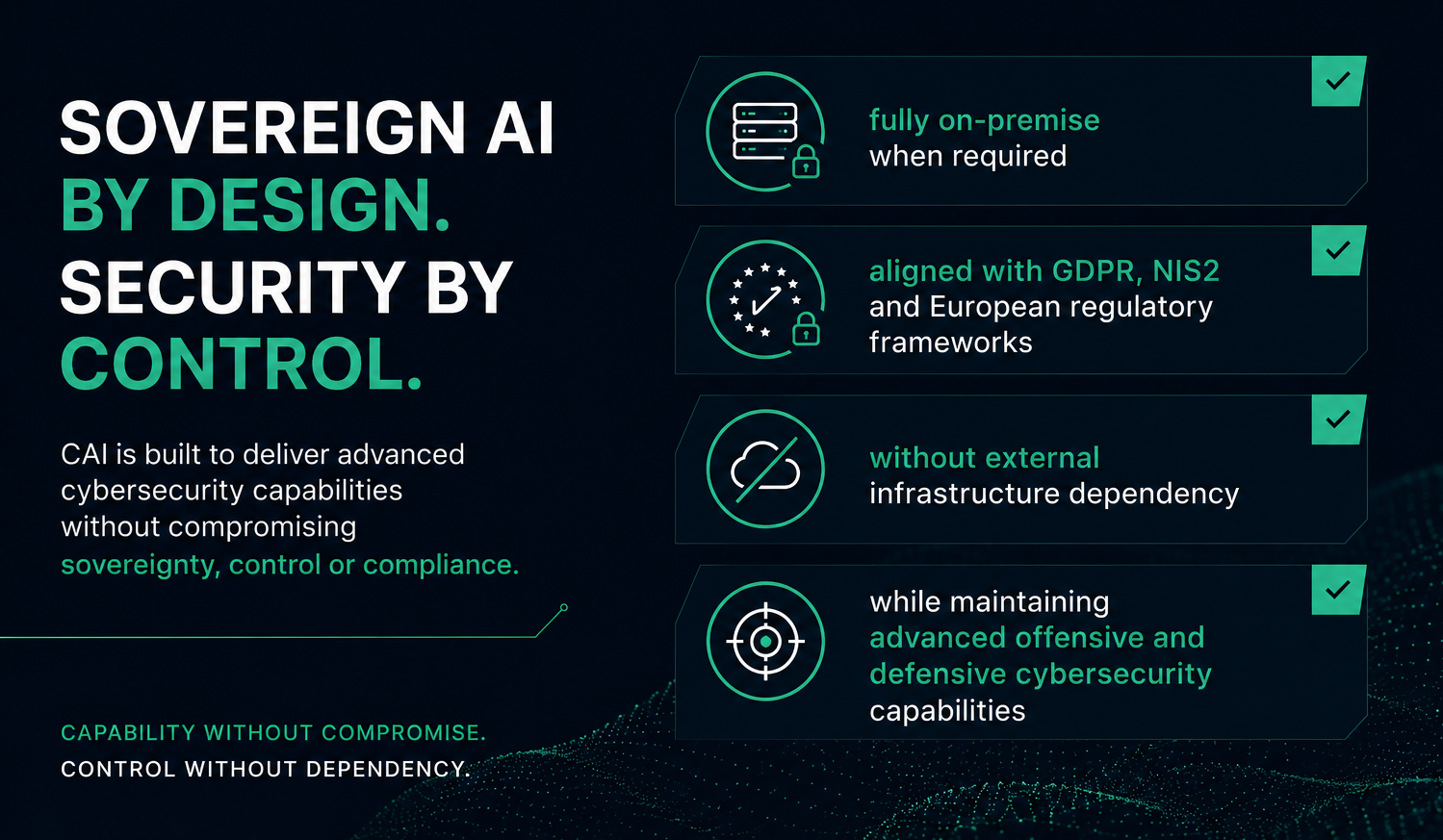
This is why Alias Robotics approaches cybersecurity AI from a fundamentally different architectural principle. Sensitive security operations should never depend on external, black-box cloud services.
Our Cybersecurity AI (CAI) platform is designed to support offensive and defensive workflows while preserving total control over the operational environment. Instead of treating AI as a remote assistant that extracts sensitive telemetry, CAI keeps cybersecurity operations, data flows and decision-making inside the organization's own perimeter.
For organizations operating in critical or regulated environments, this capability is delivered through CAI ON PREMISE: our sovereign deployment model designed for full local execution, auditability and infrastructure control.
At the core of CAI ON PREMISE is alias2-mini, our compact cybersecurity model engineered for secure on-premise operation without dependence on third-party cloud APIs. This architecture minimizes external data exposure, aligns with NIS2 supply chain risk management requirements, and allows organizations to adopt AI without surrendering operational sovereignty.
In cybersecurity, performance without control is operational risk.
The real questions every company must ask
Before uploading a single log file to a public AI service, ask yourself:
- What is the real contract? Are we using an API, and what does it explicitly say about data retention, feedback loops, and abuse monitoring?
- Where is the data going? Where is the information physically processed, and can we audit the full data flow to prove compliance?
- What happens when things change? If the provider alters its terms or experiences an outage, how does that impact our operational continuity?
- Would we do this with a human? Would we send this exact same data to an unvetted external consultant without strict NDAs?
If the answer to any of these is unclear, you are taking on a risk you do not fully understand. For cybersecurity in critical sectors, convenience cannot dictate strategy. Defenders need AI, but they also require sovereignty, auditability, and control.
Frequently Asked Questions (FAQs)
Is using OpenAI or Anthropic always unsafe for companies?
The risk depends entirely on the specific product tier, configuration and data sensitivity. The critical error is routing highly sensitive cybersecurity workflows through these third-party systems without clear governance, data controls and absolute auditability.
What is the main cybersecurity risk of public cloud AI?
Loss of control. Cybersecurity workflows require processing highly sensitive data (system logs, vulnerabilities, architecture details). Executing this externally creates severe exposures across privacy, compliance and supply chain security.
How does on-premise AI solve the NIS2 compliance problem?
The NIS2 Directive demands strict supply chain security management. Local AI eliminates third-party data egress entirely. By keeping the most sensitive data a company owns strictly on-premise, you guarantee total auditability and remove the external vendor from your risk landscape.
Dive Deeper into Our Technology
- Discover the performance specifications of ourcompact cybersecurity model alias2-mini, the standard designed for execution on individual machines in secure environments.
- Audit the science behind our technology by visiting ourFormal Research in AI Security (CAI)repository and see how we overcome human analysis bottlenecks.
- Analyze the liability implications of theEuropean NIS2 Directiveto shield your supply chain against catastrophic third-party failures in strategic infrastructures.