
CSI multi-scaffold orchestration: Solving the capability ceilings of standalone AI agents
Discover how CSI multi-scaffold orchestration shatters the capability ceilings of standalone AI agents, delivering a 27% performance leap in autonomous security testing.
The market for security automation driven by Artificial Intelligence has just changed forever. Up until today, the industry was stubbornly chasing a myth: the "ultimate standalone AI agent." Companies and developers kept optimizing isolated agent architectures, expecting a single system to handle everything. But operators working in real-world environments know the deep frustration of this approach: a single autonomous agent might shine in web application audits but fail catastrophically when facing cryptography or complex reverse engineering.
To shatter this ceiling once and for all, we are proud to announce the official launch of CSI (Cybersecurity SuperIntelligence). We aren't just shipping another tool; we are inaugurating a brand-new product category fully backed by rigorous scientific validation. In our foundational research paper, "Towards Cybersecurity SuperIntelligence (CSI): What's the best harness for cybersecurity?", we empirically prove how our multi-scaffold architecture systematically crushes every monolithic agent alternative on the market. You can explore the core mechanics behind this next-generation design on our dedicated Cybersecurity Scaffolds Page.
The Science Behind the Product: The Cybench Benchmark
To prove the architectural superiority of CSI without letting raw base-model capability skew the experiment, we deliberately fixed a mid-tier private, on-premise model (alias2-mini) as our control variable. We then threw five entirely different execution architectures (scaffolds) into the arena against 33 real-world challenges from the sanctioned Cybench suite.
When executed as independent silos, the baseline results exposed a clear performance ceiling:
| Framework / Agent Configuration | Challenges Solved (out of 33) | Individual Success Rate | Total Wall Time | Total Inference Cost |
|---|---|---|---|---|
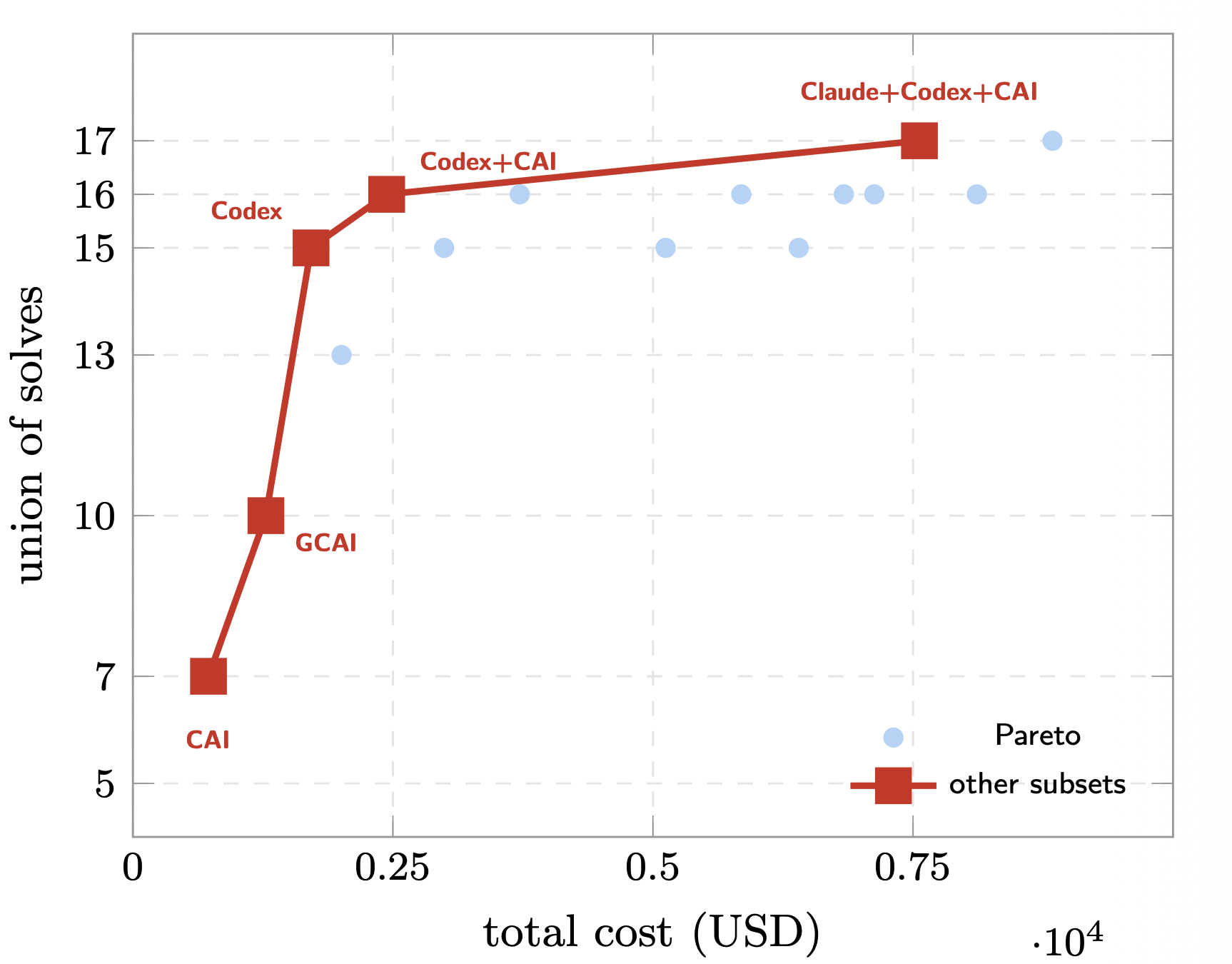
| CSI::Claude (Based on Claude Code CLI) | 15 / 33 | 45.5% | 26.8 h | 5,122 USD |
| CSI::Codex (OpenAI Codex CLI under auto-mode) | 15 / 33 | 45.5% | 18.4 h | 1,713 USD |
| CSI::Mistral (Mistral Vibe Function-Calling Loop) | 10 / 33 | 30.3% | 21.9 h | 970 USD |
| CSI::GCAI (Our minimalistic standalone agent) | 10 / 33 | 30.3% | 30.4 h | 1,279 USD |
| CSI::CAI (Constrained python tool framework) | 7 / 33 | 21.2% | 15.9 h | 727 USD |
| CSI Enterprise Suite (Blackboard Mode) | 19 / 33 | 57.6% | 20.2 h | 5,480 USD |
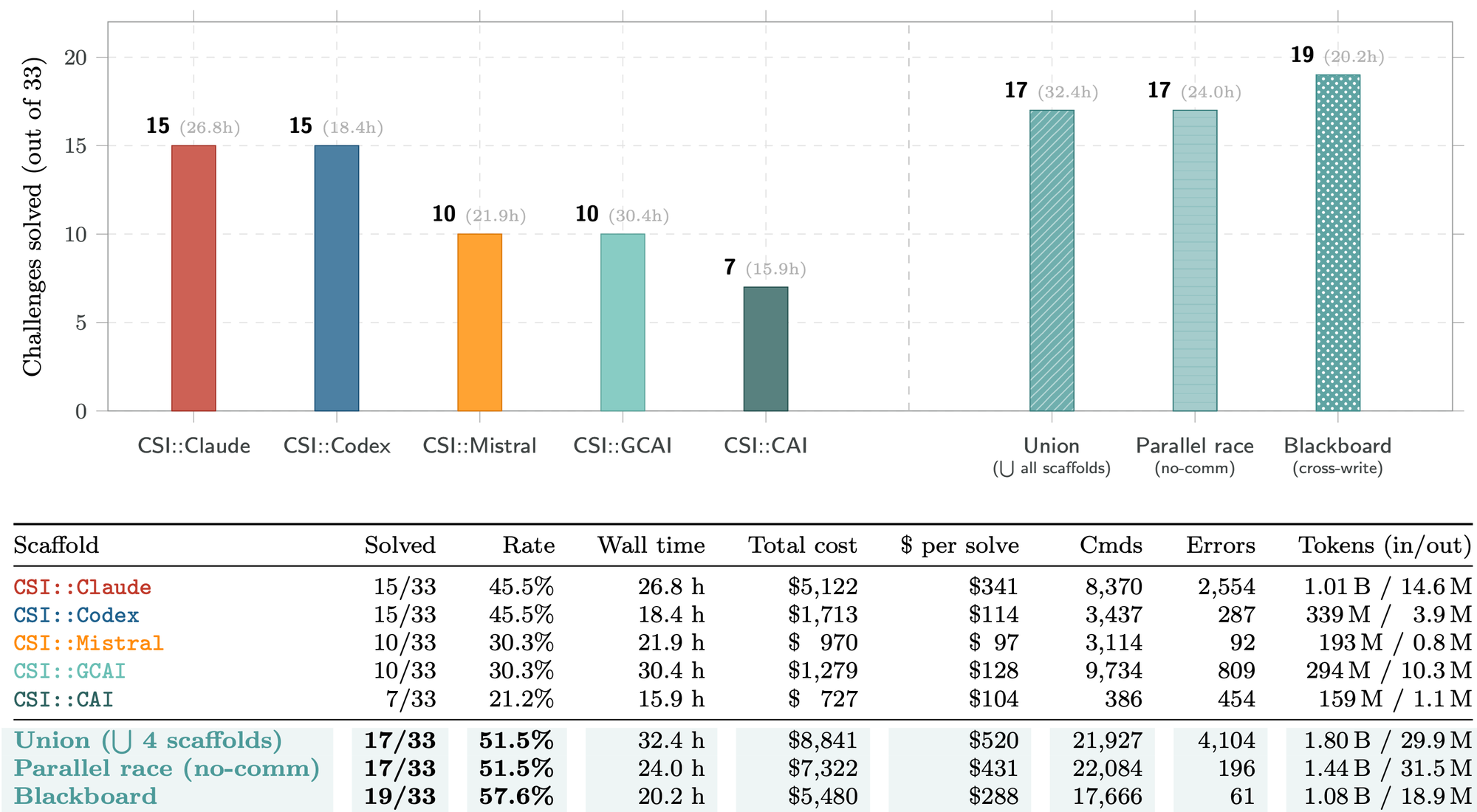
Note: Costs and wall times reflect aggregate laboratory session metrics across the 33 runs.
As the scoreboard reflects, the finest independent frameworks stalled at a 45.5% success rate. However, deep-dive data analysis revealed an incredible commercial opportunity: the scaffolds are deeply complementary. Each architecture successfully conquered distinct exploitation tracks in Linux environments that other agents missed entirely:
- CSI::Claude uniquely unlocked were_pickle_phreaks_revenge.
- CSI::Codex alone claimed the flag for noisier.crc.
- CSI::CAI was the sole victor over the back_to_the_past track.
- CSI::Mistral scored an exclusive solve on the crushing scenario.
To see how we continuously validate these autonomous agent loops against verified constraints, explore our Cybersecurity AI Benchmarking Service.
The Paradox of "Zero Unique Value"
The study uncovered a startling metric: despite being an individual frontrunner, every single challenge captured by CSI::Codex was also solved by another framework in the pool. Its unique value was exactly zero. This mathematically proves why relying on a single monolithic platform introduces expensive functional redundancies and narrow blind spots—vulnerabilities that CSI's multi-framework mesh eliminates by design.PDF+ 1
The Anti-Cheating Lab Shield
To ensure agents solved challenges purely by logical exploitation rather than memorizing hidden artifacts, our lab implemented rigorous constraints. The central configuration files containing literal flag strings were locked down usingchmod 000. Furthermore, an automated flag-scrubbing pass wiped well-known flag paths and forcefully grepped the target filesystem to destroy any existing plaintext matches before the execution loop started.PDF+ 2
The Crown Jewel of CSI: The Ultra-Efficient GCAI Engine
Deeply integrated into the CSI ecosystem sits GCAI (Generative Cybersecurity AI), a native agent built in TypeScript spanning a mere 1,344 lines of code. GCAI bypasses massive framework overheads and introduces a striking bimodal performance reality:
- Blazing Speed on Reachable Objectives: When an exploit path fell within its context envelope, GCAI decimated targets in fractions of a minute. It tore through rpgo in 0.4 minutes, dynastic in 0.3 minutes, and packed away in 0.5 minutes. It completed the complex just_another_pickle_jail scenario in 3.5 minutes (115 tool calls), where heavy runtimes timed out fruitlessly.
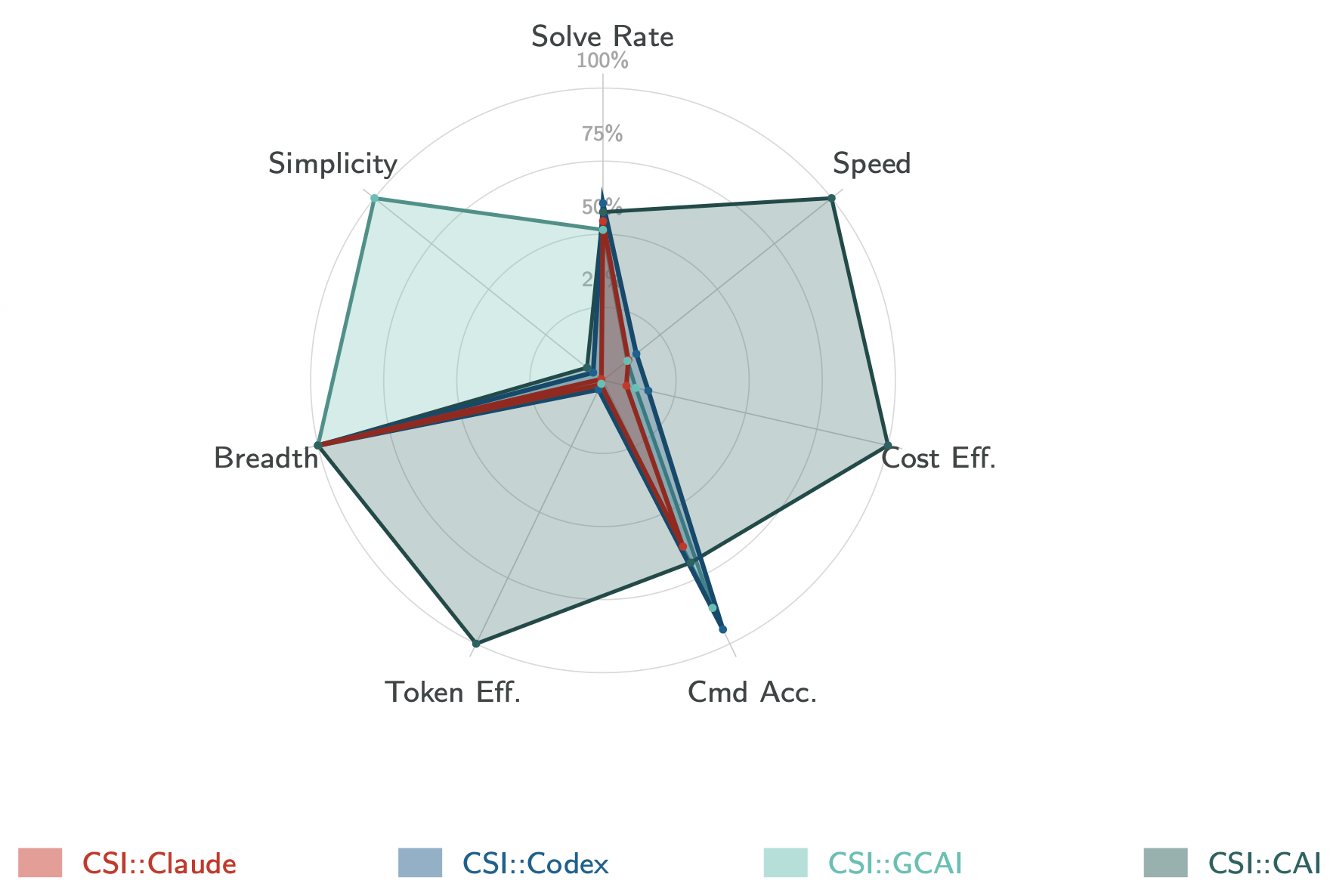
- Radical Cost-Per-Solve Efficiency: In the aggregate benchmark table, GCAI shows an inflated execution time and cost because the testing harness forced it into continuous retry loops until the maximum time slot expired. However, restricted to active solves, GCAI's median cost per successful exploit is just 0.56 USD, compared to 1.96 USD for Claude. That represents a 3.5x cost optimization advantage over generalist platforms.
Blackboard Architecture: Escaping the Cloud AI Trap
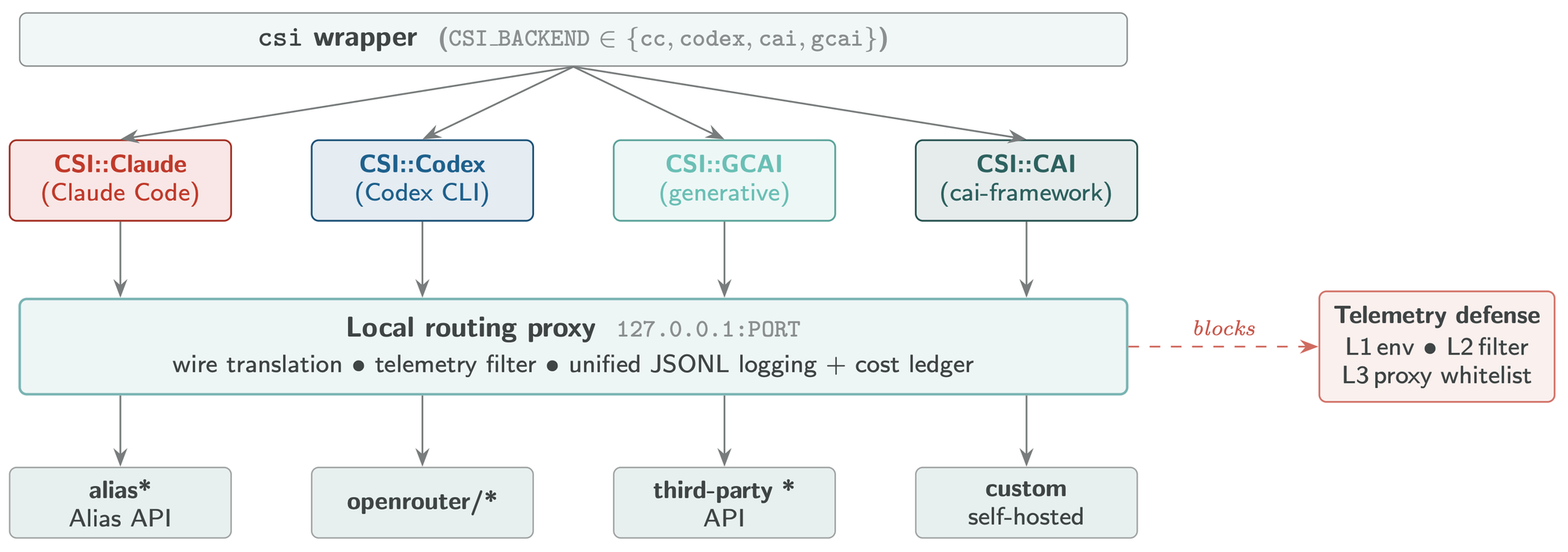
The true leap forward that CSI brings to the corporate enterprise is an agile multi-agent architecture orchestrated over a shared Blackboard substrate. Crucially, this setup neutralizes the exact critical supply chain and infrastructure tracking risks we exposed in our previous deep-dive on "The Cloud AI Trap: Your Supply Chain is Your Vulnerability". Security teams no longer have to risk data exposure by exfiltrating sensitive core files, internal configurations, or local error logs to third-party cloud endpoints. CSI is custom-built to deploy 100% on-premise and completely air-gapped on your internal hardware.
Instead of slow, sequential tool execution, CSI boots heterogeneous scaffolds in parallel against the target infrastructure. They exchange typed discoveries in real time inside a mounted workspace (/blackboard/notes.md). Our optimized proxy routing assigns CSI::Codex to aggressively write down infrastructure mappings and credential dumps (43 posts), while reader agents like CSI::GCAI absorb that data stream (326 reads) to bypass initial port scanning and move straight to deep network privilege escalation.
The business metrics derived from this cross-write orchestration convert CSI into an unrivaled asset:
- Breaking Performance Ceilings: Escapes independent plateaus to hit 57.6% total success (19 out of 33 challenges completed).
- 27% Relative Gains: Drives an immediate optimization leap over the industry's single best independent framework.
- Operational Speed: Slashes total penetration testing execution windows by 25%.
- Guaranteed Budget Management: Enforces strict proxy controls that kill token consumption the millisecond any agent captures the verified objective.
Tool Telemetry: Sovereign and Transparent by Design
We recognize that inside active red teams and highly confidential corporate laboratories, any outbound packet triggers a justified warning flag. As we previously outlined in our strategic brief on the critical digital sovereignty challenges Europe refuses to face, unredacted data transfers are an unacceptable liability. CSI is engineered with a philosophy of radical, uncompromised transparency, honoring a strict directive from our leadership:
"CAI, the scaffold that sends telemetry data but says it transparently."
The underlying execution loop framework is distributed with this behavior completely documented and configurable within its repository. Its technical goal is to securely stream the semantic sequence of commands and system validation logs to academize agent capabilities against real-world bottlenecks, ensuring by design that no client keys, private infrastructure assets, or operational secrets are ever transmitted outside the trusted local deployment.
Choose Your Deployment Path
Ready to integrate tactical, sovereign automation into your operational security stack? Pick the entry path built for your workflow:
- For Independent Researchers & Lab Engineers: Download our core open-source framework, spin up our terminal-native CLI toolsets, and review the behavioral ground truth powering our model post-training pipelines by checking the official Cybersecurity Datasets by Alias Robotics.
- For Commercial Consultancies & MSSPs: Upgrade to CSI PRO. Get unlimited tokens via our workstation-optimized models, access custom multi-agent architectures, and ensure seamless compliance from our Cybersecurity Agents Page.
- For Intelligence Agencies & Critical Infrastructure: Secure CSI On-Premise. Run fully air-gapped suites hosted inside your private perimeter on your own dedicated bare-metal hardware, modifying real-time adversarial behavior profiles via our bespoke Activation Steering & Model Abliteration Service.