


XBOW vs CAI: Assessments vs Security Capability
A breakdown of why CAI and XBOW represent two fundamentally different security models, and why building in-house security capability scales better than buying one-off assessments

If you follow the cybersecurity AI space, you have probably seen the same question come up repeatedly: How does CAI compare to XBOW?
It is a reasonable question, but it is also the wrong way to frame the discussion. CAI and XBOW are not competing on features. They represent two fundamentally different approaches to security.
What XBOW Is Optimized For
XBOW is designed to deliver security assessments. Its model focuses on running AI-driven evaluations, identifying issues, and producing reports that describe the security posture of a system at a specific point in time.
For organizations that need fast external insights or one-off evaluations, this approach can be useful.
However, this model has an inherent limitation. Once the assessment is completed and the report is delivered, the value stops growing. Each new evaluation requires starting again, often with similar effort and cost.
What CAI Is Optimized For
CAI was built with a different objective.
Instead of delivering assessments, CAI focuses on building in-house security capability. Its purpose is not to generate reports, but to enable teams to continuously analyze, test and improve their own environments.
With CAI, security agents operate directly inside the organization’s infrastructure. Workflows are reusable and evolve over time. Findings are transformed into automation procedures that can be executed again, refined, and extended.
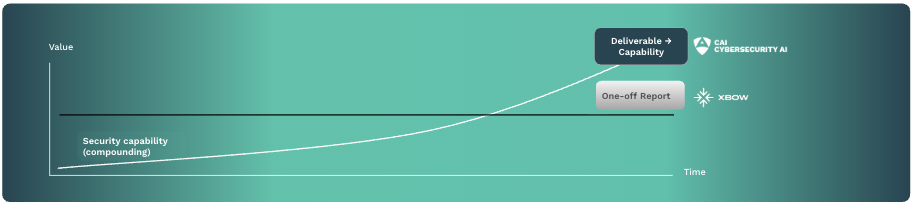
The result is not a static deliverable, but a growing internal capability.
Over time, this approach compounds. Detection becomes faster, response improves, and the marginal cost of each new assessment decreases. Most importantly, teams reduce their dependency on external services and gain ownership of their security processes.
Assessments vs Capability
The difference between CAI and XBOW is therefore not about which platform has more features or better AI.
It is about what organizations are actually buying.
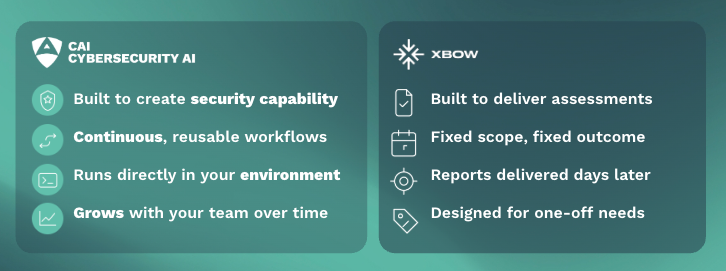
Both approaches can coexist, and each may be appropriate in different contexts.
If the goal is to outsource assessments and receive point-in-time reports, platforms like XBOW may be a suitable choice.
If the goal is to build security in-house and scale it over time, CAI was designed for that purpose.
Why We Chose a Different Path
At Alias Robotics, we believe that modern security teams need more than reports. They need ownership, repeatability, and systems that improve with use.
That is why CAI is built as an open-source framework, powered by autonomous and human-supervised AI agents, and supported by a cost model that scales for continuous security rather than short-term experimentation.
Security That Grows Over Time
The real shift happening in cybersecurity is not simply from humans to AI.
It is a shift from one-off evaluations to compounding security capability.
Reports fade.
Capabilities compound.
That is the difference.

Want to explore what in-house, autonomous security looks like in practice?
Get started with CAI.
Explore how these research insights translate into practical, scalable security with CAI — and join the conversation by following us on LinkedIn and X, or collaborating with the community on our Discord server.